Product leadership
at platform scale.
Eight years at Petpooja — India's largest restaurant tech platform — building the technology ecosystem serving 1,00,000+ outlets. I own products end-to-end: strategy, system architecture, cross-functional execution, and the metrics that confirm whether you were right.
Now looking for my next role as a Group Product Manager or Head of Product.
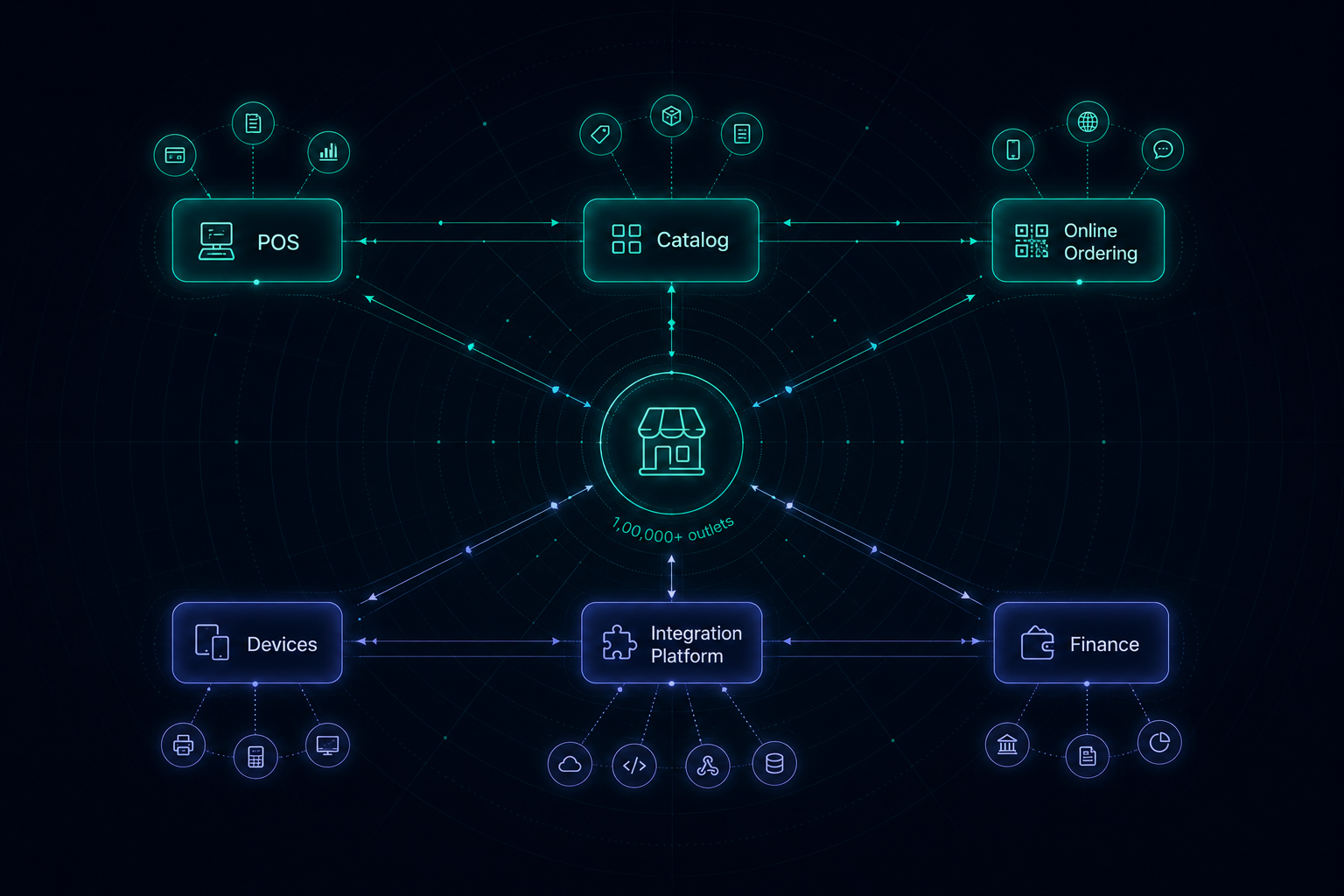
Platform Impact
Restaurant Technology · Commerce Platforms · Platform Architecture
About
I build the layer that makes complex systems feel simple to operators.
Most restaurant technology is built as a collection of disconnected tools. A menu update in the POS doesn't reach the aggregator. A price change at brand HQ takes days to reach outlet 47. I build the connections — the data models, the propagation engines, the platform contracts — that make those things automatic.
My operating model: understand the operational workflow deeply before writing a spec, design for the integration boundary before the feature surface, and measure against metrics that reflect the actual business outcome — not proxy indicators.
I've been wrong in ways that mattered. I built a permission model that was technically elegant but operationally useless — outlet managers couldn't mark items out of stock without brand-level approval. Three operators rejected the beta before I fixed it. Being wrong faster is a skill I've deliberately developed.
Product Domains
Four domain clusters. Full ownership across each.
All productsRestaurant Operations
- Restaurant POS Systems
- KOT & Kitchen Management
- Table & Floor Management
- Multi-Terminal Workflows
- Offline-First Operations
Commerce & Ordering
- Catalog Management Systems
- Online Ordering Ecosystems
- Aggregator Integrations
- QR Menu & Dine-In
- Multi-Channel Sync
Platform & Integration
- Backend Platform Architecture
- Integration Platform & APIs
- Multi-Brand Operations
- Android Application Fleet
- Event-Driven Systems
Merchant Solutions
- Finance Enablement Products
- Settlement & Reconciliation
- GST & Tax Compliance
- Payment Infrastructure
- Merchant Analytics
Featured Case Studies
The problem, the decision, the outcome.
All 8 case studiesCatalog Management Platform
The Problem
A 200-outlet chain was spending 3 days manually propagating a single price change across aggregators, POS terminals, and the website — with inconsistencies at every step.
The Insight
The problem wasn't coordination — it was architecture. A shared catalog with an automated propagation engine made consistency a system property, not a manual discipline.
The Outcome
Menu propagation: 3 days → 4 hours. 1,00,000+ outlets on unified catalog. Manual ops effort −78%.
Partner Integration Platform
The Problem
Every new aggregator integration was a 5-week custom engineering project. The integration team was permanently backlogged and had no leverage as the partner ecosystem grew.
The Insight
Treating integrations as a product — canonical events, adapter pattern, production-fidelity sandbox — made each new partner a configuration exercise, not a project.
The Outcome
Onboarding: 5 weeks → 1 week. 150+ integrations live. 99.4% order acceptance rate.
Online Ordering Backend Architecture
The Problem
The online ordering pipeline had frequent, undetected failures under load. Orders silently dropped. Merchants discovered issues from customer complaints — not from monitoring.
The Insight
Reliability at this scale isn't a feature — it's an architecture property. Layered fallbacks, idempotent retries, and a dedicated alerting pipeline made failure detection a system responsibility, not a manual one.
The Outcome
99.6% order pipeline reliability. <60s failure detection. 0 silent order drops. MTTD: 6hrs → 8min.
Product Philosophy
Four things I believe, with evidence.
Not principles from a framework. Things that came from building operational software at scale and watching what breaks.
Systems fail at the seams, not the centre.
The POS worked. The kitchen system worked. Orders still got lost — because no one designed the handoff. I start every product with the integration boundary: what data crosses it, in what shape, and what happens when it doesn't arrive.
Operators don't have time to learn software.
I spent two weeks in restaurants before writing the POS spec. During a lunch rush, a cashier will not read an error message — she'll press Cancel and start over. The product has to be right on the first tap, every time.
A catalog updated once should be everywhere in minutes.
Before I built the catalog system, a 200-outlet chain took 3 days to push a price change — manually, aggregator by aggregator. I made that propagation automatic and guaranteed. Not as a feature. As a platform invariant.
Internal APIs have users too.
I treat platform foundations like public products — versioned, documented, with explicit contracts. The 40% build-time reduction didn't come from working faster. It came from building predictable surfaces that other teams could rely on without asking.
Technology & Platform Expertise
Technical depth, applied as a PM.
I don't write production code. I do write system design specs, challenge architecture decisions, define API contracts, and hold engineering teams accountable to platform quality.
Data Architecture
Hierarchical data models, inheritance patterns, multi-tenant schema design. I've designed catalog schemas that serve 1,00,000+ outlets simultaneously from a single canonical store.
Event-Driven Systems
Producer/consumer patterns, event schema design, delivery guarantees, idempotency. I've written the specs for the event backbone that decoupled six platform services.
API & Integration Design
REST and gRPC API contracts, versioning strategy, sandbox environments, adapter patterns. I've designed the integration platform that onboards external partners in days.
Mobile & Android
Offline-first architecture, SQLite-backed local stores, OTA fleet management, role-specific UX for constrained hardware. 8,500+ devices in production.
Platform Scalability
Domain service decomposition, circuit breakers, cascading failure prevention. I designed the backend architecture that drives 99.6% order pipeline reliability at peak load.
Commerce Infrastructure
Multi-channel order routing, aggregator sync, payment flow design, reconciliation engines. Payment reliability, settlement transparency, and automated reconciliation at scale.
Career Journey
Eight years of compounding scope.
Petpooja scaled from a regional tool to India's largest restaurant tech platform during my tenure — starting in sales, moving through operations, and into product. I've operated as de facto Head of Product for the restaurant technology division.
BDE → Operations Manager
Petpooja
Started in business development and progressed to operations leadership. Built strong commercial understanding, onboarding systems, and cross-team execution discipline before transitioning into product management.
- Progressed from sales to operations leadership
- Led operational execution and onboarding systems
- Developed cross-team coordination and commercial acumen
Product Manager
Petpooja
Transitioned into product to own merchant-facing tools, the integration platform, GST compliance system, finance enablement, and the Android restaurant application fleet.
- GST standardization — 67% compliance error reduction
- Partner integration platform — 5 wks → 1 week onboarding, 150+ integrations
- Android fleet: 99.1% crash-free rate across 8,500+ devices
Senior Product Manager — Restaurant Technology
Petpooja
Lead the full restaurant technology stack — POS, catalog, online ordering, dine-in, multi-brand, integration platform, and backend architecture. Operating as de facto Head of Product for the division. 1,00,000+ outlets across all products.
- Catalog platform: 3 days → 4 hrs propagation across 1,00,000+ outlets
- Online ordering reliability: 99.6% pipeline, 6hrs → 8min MTTD
- UPI success rate: 97.4% (up from 93.1%), 97.4% automated reconciliation
Contact
Actively looking for my next role.
Targeting Group PM, Head of Product, and Senior PM roles at technology companies building complex operational software, commerce platforms, or SaaS at scale.
I respond to all recruiter and hiring manager outreach within 24 hours. Open to remote and relocation.